CQC Registration Rejection: Why Applications Are Being Refused and How to Fight Back
So, you’ve spent months preparing your CQC registration application. You’ve compiled policies, arranged interviews, organised premises inspections, paid the fees—and then the bombshell drops. A Notice of Proposal to Refuse Registration lands in your inbox, and suddenly, all those plans to open your care service are hanging by a thread.
Welcome to 2025, where the Care Quality Commission is rejecting applications at rates that would make a university admissions office blush. Nearly 90% of registration applications now get bounced back for incompleteness, and even those that make it through the validation stage face increasingly rigorous scrutiny that’s catching out applicants who thought they’d done everything right.
The CQC isn’t being difficult for the sake of it—well, not entirely. The regulator has faced its own existential crisis, been declared “not fit for purpose” by government ministers, and is now scrambling to rebuild credibility through stricter oversight. Unfortunately, you’re caught in the crossfire.
If you’re facing CQC registration rejection, you need to understand what’s changed, why applications are failing, and most importantly, whether to fight the decision or withdraw and start again. Because here’s the uncomfortable truth: the wrong choice could cost you months of delays and tens of thousands of pounds.
The CQC’s Crisis That’s Affecting Your Application
Let’s start with some context about why the CQC has suddenly become so difficult to please. In October 2024, Dr Penny Dash published an independent review that essentially concluded the CQC had failed at its core mission. Professor Sir Mike Richards’ parallel review found similar problems. Health Secretary Wes Streeting didn’t mince words, stating he was “stunned by the findings,” whilst Minister Karin Smyth went further, declaring the CQC “not fit for purpose.”
The statistics paint a grim picture. By the end of 2023-24, more than half of pending applications had been waiting over ten weeks for completion, compared to just 22% the previous year. Homecare providers reported delays stretching to nine months. The registration system had essentially collapsed under its own weight.
So what did the CQC do? Rather than simply hiring more staff to clear backlogs, they fundamentally overhauled their approach to registration. From 18 November 2024, the entire online portal shut down. Now every application goes through downloadable forms submitted via email, and the validation process has become ruthlessly efficient at one thing: rejecting incomplete applications before they even reach substantive assessment.
The message from CQC Chair Ian Dilks was admirably direct: “The CQC has not done what it should have been doing over a period of time.” Translation: we messed up, and now we’re overcompensating by making life significantly harder for new applicants.
Why Your CQC Registration Application Got Rejected
The reasons for CQC registration rejection fall into predictable patterns, though knowing this doesn’t make it any less frustrating when it happens to you. Let’s examine the execution grounds where most applications meet their demise.
Generic policies represent the number one killer of registration applications. If your policies look like they’ve been downloaded from a template library—because they have been—the CQC will spot this immediately. They’re not impressed by fifty pages of beautifully formatted procedures that could apply to absolutely any care service in England. They want to see documentation that reflects how your specific service will actually operate, with your staff, in your premises, serving your particular client group.
Your Statement of Purpose needs similar specificity. Vague descriptions about “providing high-quality person-centred care” don’t cut it anymore. The CQC wants concrete details about your aims, objectives, service model, and exactly which regulated activities you’ll carry out. If your Statement of Purpose could describe fifty different care services with equal accuracy, it’s too generic.
Form completion errors that previously might have triggered a polite email requesting clarification now result in instant rejection. Mismatched addresses between Companies House records and your application? Rejected. DBS check dated thirteen months ago instead of twelve? Rejected. A blank field you didn’t notice? Rejected. The CQC explicitly states they will “routinely return and reject applications that are not complete or accurate at the point of receipt, without the need for a full registration assessment.”
Interview performance has become a critical rejection point. Your proposed registered manager needs to demonstrate genuine understanding of CQC regulations, not just claim they’re familiar with them. Recent tribunal cases reveal applicants who couldn’t explain the difference between a Notice of Proposal and Notice of Decision, or between being a Nominated Individual versus Registered Provider. The CQC interviewer documented one GP applicant dismissing such knowledge as “not at the top of my working knowledge”—shortly before their application was refused.
Professional qualifications face heightened scrutiny, particularly for medical practitioners venturing outside their core specialty. A GP wanting to operate a dermatology clinic needs to demonstrate dermatology competence, not just GMC registration. A nurse-led clinic providing services beyond standard nursing practice must show appropriate oversight by qualified professionals. The CQC has moved decisively away from assuming that “qualified healthcare professional” automatically equals “competent to provide this specific regulated activity.”
The Two Routes When Facing CQC Registration Rejection
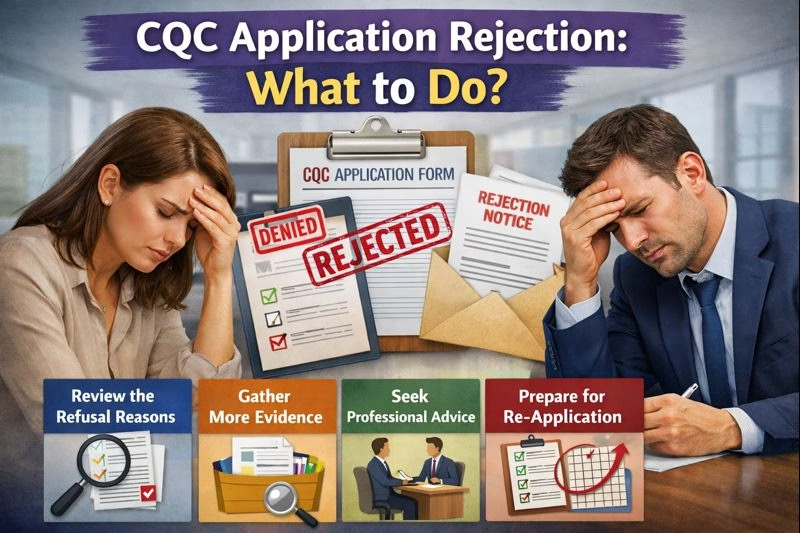
When you receive a Notice of Proposal to Refuse, you face a fork in the road. One path leads through representations and potentially tribunal appeal. The other involves withdrawing your application and starting fresh. Both have advantages and serious drawbacks, and choosing wrong could prove expensive in time and money.
The appeal route starts with understanding that the Notice of Proposal isn’t the final decision—it’s actually an opportunity. You have twenty-eight calendar days to submit written representations explaining why the CQC’s concerns are misplaced or have been addressed. This isn’t a formal legal proceeding; it’s a chance to provide additional evidence, clarify misunderstandings, submit updated policies, or demonstrate improvements you’ve made since the original assessment.
The CQC’s National Representations Team reviews your submission within approximately sixty working days—though no statutory timescale exists, so “approximately” is doing heavy lifting in that sentence. If they accept your representations, registration proceeds. If they don’t, they issue a Notice of Decision, which triggers the formal appeal window.
At this stage, you have another twenty-eight days to appeal to the First-tier Tribunal (Health, Education and Social Care Chamber). This is where things get interesting. The tribunal doesn’t just review whether the CQC’s original decision was reasonable—it makes a completely fresh decision based on circumstances at the time of the hearing. This fundamentally changes the strategic calculation.
Consider the Westhope Limited case from March 2025. Even though the service had closed by the time of hearing, the tribunal allowed the appeal because CQC’s decision had been “disproportionate.” The tribunal established that improvements need only reach “a level that, even if still below the Respondent’s wider expectations, rendered the relevant regulatory action disproportionate.” In plain English: you don’t need to be perfect, just good enough to make rejection unreasonable.
Quality Care Group achieved similar success by engaging specialist solicitors who developed strategy within the twenty-eight day window, cross-referenced grounds for appeal to supporting evidence, and benefited from a CQC reinspection during proceedings that found positive changes. CQC agreed to a Consent Order without requiring a full hearing.
The reapplication route offers different advantages. Your Notice of Proposal provides detailed intelligence about exactly what the CQC found inadequate. You now know what “good enough” looks like for your specific application. If the underlying problems are fundamental—wrong registered manager, unsuitable premises, completely inadequate financial resources—addressing these through a fresh application might prove faster than arguing a weak position through tribunal.
The CQC explicitly states that refusal doesn’t prejudice future applications. Each is considered on its merits. A withdrawn application cannot damage future prospects, though obviously the same fundamental issues will produce the same result if not properly addressed.
The Brutal Mathematics of Appeals vs Reapplication
Let’s talk about what each route actually costs, because understanding the financial implications helps clarify your decision dramatically.
The First-tier Tribunal charges no fees for Care Standards appeals. That’s the good news. The less good news is that legal costs escalate rapidly based on complexity. Initial advice and representation preparation typically costs between £2,000 and £5,000. Full appeal preparation adds another £3,000 to £10,000. If the appeal proceeds to hearing, you’re looking at £10,000 to £30,000 or more. Complex cases extending over multiple hearings can reach £30,000 to £50,000.
Each party generally bears their own costs regardless of outcome. Losing an appeal doesn’t typically trigger adverse costs orders, though exceptions exist if conduct has been unreasonable. Still, spending £20,000 on legal fees to win an appeal feels like a pyrrhic victory when you’ve haemorrhaged cash throughout the process.
Reapplication avoids legal fees but doesn’t avoid costs entirely. You’ll pay the CQC application fee again—anywhere from £800 to £2,500 depending on service type. More significantly, you face delay costs. With current processing times averaging 121 days for complex applications and increasing by 16.1% year-on-year, reapplication could mean waiting another six to nine months for a decision.
If you have contracts contingent on CQC registration, every month of delay represents lost revenue. If you’ve already hired staff, you’re paying salaries without income. If you’ve leased premises, rent continues accruing. These delay costs can dwarf legal fees surprisingly quickly.
The strategic calculation becomes: does your case have merit, or are the CQC’s concerns fundamentally correct? If you genuinely have a poor registered manager who doesn’t understand regulations, no amount of tribunal advocacy will change that reality. But if you have a competent manager who performed poorly in interview due to nerves, or premises that needed minor modifications now completed, or policies that were inadequate but have since been comprehensively rewritten, appeal might succeed where reapplication would just restart the clock.
What Actually Wins Appeals (And What Doesn’t)
Having reviewed multiple tribunal decisions and practitioner observations, patterns emerge clearly about what separates successful appeals from unsuccessful ones.
Successful appeals demonstrate three essential elements. First, documented evidence of improvements since the original decision. The Clarendon Care Group succeeded by immediately installing new management, providing detailed risk reduction plans, and engaging proactively with CQC. The tribunal found imposed conditions “disproportionate” given improvements made. Photographs of upgraded premises, external audit reports, updated policies with version control showing development dates—these carry weight.
Second, willingness to acknowledge legitimate concerns rather than disputing everything. Providers who claim the CQC inspector was completely wrong about everything face uphill battles. Those who accept some criticisms were valid but show they’ve addressed them appear reasonable and responsible. The tribunal wants to see that you understand what went wrong and have fixed it, not that you think the entire regulatory system is persecuting you unfairly.
Third, focus on proportionality. The tribunal assesses whether CQC’s decision is proportionate to actual risks. Even if you’re not perfect, if you’re safe and adequate, complete refusal may be disproportionate. The Westhope case established this principle clearly—you don’t need to exceed all CQC expectations, just meet the threshold where refusal becomes unreasonable.
Unsuccessful appeals share different characteristics. Fortress Supported Living Services failed because they didn’t acknowledge actual failings and didn’t act decisively to address concerns. Care Management Group’s appeal to increase service users from seven to ten failed when the tribunal gave considerable weight to national guidance and found CQC’s refusal “fair, reasonable and proportionate.”
Generic arguments about how unfair the CQC is being, without specific evidence addressing their concerns, rarely succeed. Neither do appeals that essentially argue “we promise we’ll fix things after you approve us.” The tribunal wants to see evidence of current compliance, not future intentions.
The Uncomfortable Truth About CQC Registration in 2025
Here’s what nobody in the sector wants to say loudly but everyone knows: CQC registration has fundamentally changed from an administrative process to a rigorous gatekeeping function. The approximately 90% rejection rate for incomplete applications isn’t a temporary blip or administrative bottleneck—it represents deliberate policy to strengthen oversight.
The CQC’s 2025/26 Business Plan sets ambitious recovery targets: 80% of applications receiving decisions within ten weeks from Q3 2025/26, with zero applications remaining over ten weeks by year-end. New leadership under CEO Sir Julian Hartley and Chair Professor Sir Mike Richards signals institutional commitment to improvement. But “improvement” means faster processing of higher-quality applications, not easier approval of marginal ones.
For providers, this means treating registration as a substantial compliance project rather than routine paperwork. The permissive approach of previous years, where adequate-but-imperfect applications eventually ground through to approval, has ended. The new paradigm demands excellence from the outset.
Professional preparation has shifted from optional nice-to-have to practical necessity. Comprehensive, tailored policies. Registered managers who can confidently articulate regulatory knowledge in interviews. Complete documentation with no gaps or inconsistencies. Premises genuinely ready for inspection, not “we’ll finish that room next week.” These are now baseline requirements, not stretch goals.
For those facing CQC registration rejection, the two-stage challenge process offers meaningful opportunity for reversal, but only where demonstrable improvements can be evidenced. The tribunal’s focus on current circumstances creates space for redemption, but you need to show you’ve actually addressed concerns, not just argued they weren’t valid.
The regulatory pendulum has swung decisively toward stricter standards. Adapt or fail—those are essentially the options.
How Cura Compliance Can Help With Your CQC Registration Rejection
At Cura Compliance, we’ve guided numerous clients through successful challenges to CQC registration rejections. We understand exactly what the regulator expects because we’ve seen what works—and what fails spectacularly.
When you receive a Notice of Proposal, those first twenty-eight days are absolutely critical. This is where most applications are won or lost, yet many providers waste time feeling frustrated rather than strategically responding. We review your Notice of Proposal, identify which concerns are addressable and which aren’t, and develop targeted representations that speak directly to CQC’s specific objections.
Our services for clients facing CQC registration rejection include comprehensive policy review and rewriting to address identified deficiencies, Statement of Purpose redevelopment that demonstrates genuine understanding of your service model, registered manager interview preparation that builds confidence and competence, premises readiness assessments to ensure you meet inspection standards, representation drafting that presents your strongest case within the deadline, and strategic advice on whether appeal or reapplication offers your best path forward.
We don’t promise miracles. If your application has fundamental problems—genuinely unqualified manager, unsuitable premises, inadequate resources—we’ll tell you honestly that reapplication after addressing these issues makes more sense than appealing a weak case. But where your application has merit and concerns can be addressed, we know how to marshal evidence and present arguments that succeed.
We’ve supported clients through full tribunal appeals, though we find most cases resolve earlier when strong representations demonstrate genuine improvements. The CQC doesn’t want tribunal hearings any more than you do—they’re expensive, time-consuming, and create public records of regulatory disputes. When faced with compelling evidence that their concerns have been addressed, they often agree to Consent Orders or withdraw opposition.
Our fixed-fee packages for representation preparation start from £3,500, providing certainty about costs whilst delivering professional advocacy that dramatically improves success rates. For complex cases requiring tribunal preparation, we work with specialist regulatory solicitors who understand healthcare law and have successful appeal track records.
The worst decision you can make when facing CQC registration rejection is no decision. The twenty-eight day representation window expires whether you use it or not. Acting strategically and early maximises your chances of salvaging your application without starting from scratch.
Facing CQC registration rejection and need expert guidance? Contact Cura Compliance today for a confidential discussion about your options. We’ll review your Notice of Proposal, assess your chances of success, and develop a clear strategy for moving forward—whether that’s representations, appeal, or strategic reapplication.
Key Takeaways About CQC Registration Rejection
The CQC rejects nearly 90% of applications due to incompleteness before substantive assessment even begins. Registration rejection stems from the regulator’s 2024 crisis and subsequent overhaul of processes to rebuild credibility. Common rejection grounds include generic policies, inadequate Statement of Purpose, form errors, weak manager interview performance, and professional qualification gaps. You have twenty-eight days to submit representations against a Notice of Proposal, followed by potential tribunal appeal. The tribunal makes fresh decisions based on circumstances at hearing time, not original assessment. Successful appeals demonstrate documented improvements, acknowledge legitimate concerns, and argue proportionality. Reapplication may be faster than appeal where fundamental problems exist, but appeal preserves your timeline where concerns can be addressed. Professional support significantly improves success rates for both representations and appeals.
Further Reading:
- CQC: Representations and Appeals Guidance
- The Dash Review: CQC Independent Review October 2024
- First-tier Tribunal (Care Standards) Information
- Health and Social Care Act 2008 (Regulated Activities) Regulations 2014
Last updated: January 2026