Win local authority, NHS and ICB care contracts
Local authority and ICB care contracts are scored on quality as well as price, and the Procurement Act 2023 changed how they are advertised and evaluated. We scan for opportunities in your area, write the bid and handle the submission, from £495.

experience
supported
rating
turnaround
The Procurement Act 2023 changes everything
In February 2025, the Procurement Act 2023 came into force — the biggest overhaul of UK public procurement in over a decade. Combined with the move from Clinical Commissioning Groups (CCGs) to Integrated Care Boards (ICBs) under the Health and Care Act 2022, the landscape for winning care contracts has shifted significantly.
What this means in practice: simpler competitive procedures, stronger emphasis on social value, more transparency on awarded contracts, and integrated commissioning across health and social care via ICB partnerships. Providers who understand the new framework win more bids.
What this means for you
If your last successful bid was pre-2025, your method statements and pricing strategy may be aligned to an old regime. Modernising your bid approach to the Procurement Act 2023 — and writing for ICB commissioning patterns rather than CCGs — is now critical for competitive bidding.
Sources: Cabinet Office — Procurement Act 2023; NHS England — Integrated Care Boards.

What is a care tender?
A care tender (or "bid") is a formal application to deliver services for a public-sector commissioner — typically a local authority, NHS trust, or Integrated Care Board. Commissioners use tenders to award contracts because they're legally required to run fair, transparent processes when spending public money.
Tenders come in different commercial structures, each with its own implications for how you bid and win:
| Type | What it is | How it works |
|---|---|---|
| Framework | Pre-approved supplier list for a set period | Win a place; commissioners then choose from you and others over the framework's life |
| DPS | Dynamic Purchasing System — open framework, joinable any time | Apply when ready; remain available for "call-off" contracts within scope |
| Direct contract | Single contract for a specific service | Compete for one fixed contract; winner takes all |
| Spot purchase | One-off purchase for a single placement | Quick informal procurement, often through approved providers |
Types of contracts we help win
We support providers across the full range of care commissioning pathways — from council frameworks to NHS contracts to integrated care commissioning:

LA Frameworks
Adult social care frameworks — homecare, supported living, residential.

Dynamic Purchasing Systems
Open-list frameworks councils use for ongoing call-off opportunities.

NHS Frameworks
National and regional clinical services and healthcare provision contracts.

ICB Contracts
Integrated Care Board commissioning — replaced CCGs since July 2022.

Continuing Healthcare
Specialist long-term care packages for complex health needs.

Children's services
LA-commissioned children's homes, supported accommodation and fostering frameworks.
The Cura five-stage tender approach
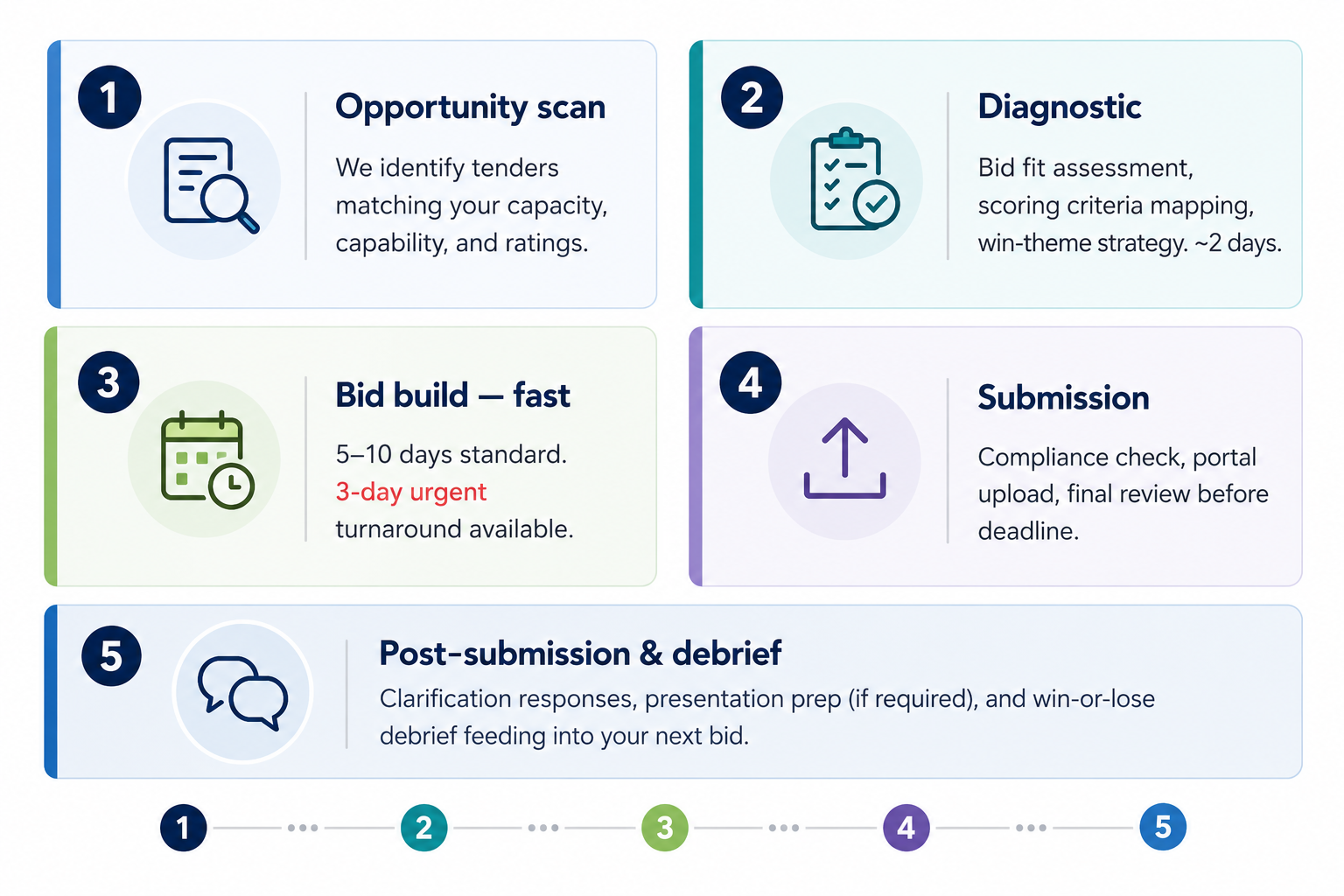
Bidding without a process is bidding to lose. Our methodology — refined across 50+ tenders — ensures every bid is positioned for the highest possible scoring outcome under the new Procurement Act framework.
Opportunity scan
We identify tenders matching your capacity, capability, and ratings.
Diagnostic
Bid fit assessment, scoring criteria mapping, win-theme strategy. ~2 days.
Bid build — fast
5–10 days standard. 3-day urgent turnaround available.
Submission
Compliance check, portal upload, final review before deadline.
Post-submission & debrief
Clarification responses, presentation prep (if required), and win-or-lose debrief feeding into your next bid.
A realistic tender lifecycle
Tender opportunities typically run 4–12 weeks from publication to deadline. Our bid-build phase is now compressed — we can deliver a competitive bid in 5–10 working days for most LA tenders, with 3-day urgent turnaround available for close-to-deadline cases.
Close to deadline?
We deliver urgent 3-day turnaround for LA tenders when you've spotted an opportunity late — get in touch and we'll start the diagnostic the same day.
Phases in teal are work we deliver. Red striped is urgent fast-track. Lighter teal is the commissioner's evaluation timeline.
What's in every tender package
Every package includes the following as standard:
| Bid fit assessment | Honest go/no-go diagnostic with scoring forecast |
| Method statements | Bespoke answers to every scored question, mapped to evaluator criteria |
| Case studies | 2–3 anonymised case studies tailored to the commissioner's priorities |
| Pricing strategy | Competitive pricing model with sustainability margin |
| Social value | Evidenced social value response aligned to the Procurement Act 2023 |
| Portal & submission | Full portal handling, document uploads, deadline management |
| Post-submission | Clarification responses + win/loss debrief |
*All packages subject to terms and conditions.
Tender support packages
Three transparent packages — choose based on bid complexity and the level of support you need*
Local Authority
tender
For single LA tenders — frameworks, DPS placements or direct contract bids.
NHS Framework
or ICB tender
For NHS Frameworks and ICB commissioning — more complex scoring, clinical governance evidence.
Multi-tender
strategy
Strategic tender programme — opportunity scanning, 3 bids in 6 months, win-rate optimisation.
*All packages subject to terms and conditions
Simple 50 / 50 payment
50% at the start to begin the bid build
50% when you win — no win, no second invoice.
Aligned to outcomes, not effort.
Common reasons care tenders lose
The most common pitfalls we see — and how our methodology addresses each:
Bidding for tenders you can't actually deliver
The biggest cause of failed bids: applying for contracts beyond your operational capacity, registration scope, or geographical reach. Commissioners spot this in scoring.
→ Our methodology: honest bid-fit diagnostic before we start building — go/no-go advice up front.
Generic method statements that don't match scoring criteria
Reusing the same answers across bids — without mapping to the specific evaluator criteria — leads to mediocre scores. Each tender has its own weighting and priorities.
→ Our methodology: every method statement written to the specific evaluator criteria for the tender.
Weak social value evidence
Under the Procurement Act 2023 and the Social Value Model, social value typically carries 10% of scoring — but most bids treat it as an afterthought.
→ Our methodology: evidenced social value response with measurable, deliverable commitments.
Pricing strategy that's either too aggressive or too soft
Underpricing wins the bid but loses you money. Overpricing loses on quality-cost ratio. The art is finding the competitive sustainable point.
→ Our methodology: pricing model that balances win probability with operational margin.
Where to find care tenders
Four main sources cover almost every care tender published in the UK. Our team monitors all of these daily on behalf of clients:
Contracts Finder (GOV.UK)
Main government portal for central government and many local authority contracts in England.
contractsfinder.service.gov.uk →Find a Tender Service (FTS)
Official site for higher-value public contracts. Larger NHS Frameworks/DPS appear here.
find-tender.service.gov.uk →Local authority e-tendering portals
Councils publish via regional portals like ProContract, Due North (London Tenders Portal) and similar.
ProContract / Due North →Specialist care-sector aggregators
Sites like Health & Social Care Tenders and Bidstats scrape and list notices from multiple portals.
Health & Social Care Tenders →Real outcomes from our clients
Anonymised summaries of recent tender wins:

Supported Living · Local Authority DPS
Won DPS placement without prior referrals, September 2025
New supported living provider applied to an LA DPS with no track record. Through bespoke method statements and direct LA communication, we secured the DPS placement and the first call-off contract within 8 weeks.

Domiciliary care · Local Authority Framework
First-time LA framework win, October 2025
Established domiciliary provider expanding into a new region. We built the bid around CQC-aligned governance evidence and competitive pricing. Awarded framework place at first attempt.

Specialist care · ICB Continuing Healthcare
Won ICB CHC contract, 12-week process
Specialist provider bidding for an ICB-commissioned Continuing Healthcare contract. Complex clinical governance requirements. Bid scored well above the winning threshold. Substantial annual contract value.
Frequently asked questions
Yes, for almost every care tender. Most local authority, NHS and ICB commissioners require providers to be registered with the relevant regulator (CQC for England adult care/health, Ofsted for children’s services, Care Inspectorate for Scotland, CIW for Wales) as a minimum entry criterion. Some DPS frameworks accept applications conditional on registration being completed before contract award.
A Framework is a pre-approved supplier list for a set period (typically 4 years); commissioners then choose from that list. A DPS (Dynamic Purchasing System) is an open framework you can join at any time, remaining available for call-off contracts. A direct contract is a single competition for one specific service — winner takes all. Each requires a different bidding strategy.
Social value is the wider benefit your service delivers to communities beyond the core contract — local employment, training, environmental impact, support for SMEs. Under the Procurement Act 2023 and Social Value Model, it typically carries 10% of the scoring weight in central government contracts and is increasingly common in local authority and NHS bids.
Clinical Commissioning Groups (CCGs) were abolished in July 2022 under the Health and Care Act 2022 and replaced by Integrated Care Boards (ICBs). There are 42 ICBs in England, each leading an Integrated Care System covering both health and social care commissioning across a defined geography. They have broader remit, more strategic powers, and operate within Integrated Care Partnerships.
Yes. We can review work already done, identify gaps and areas for improvement, and complete the remaining sections. This is common — often providers start with confidence and hit problems on social value or method statements. We can typically jump in mid-process and bring it to submission standard.
A method statement is your detailed answer to a scored question in the tender. Commissioners typically ask 5–15 method statement questions covering quality, safeguarding, mobilisation, governance, and similar areas. Each is evaluated against published scoring criteria. Method statements are where bids are won or lost.
From publication of the opportunity to contract award, most tenders run 8–16 weeks: 4–12 weeks for the bid window plus 4–6 weeks for commissioner evaluation. Our bid-build work fits inside that window — typically 5–10 days standard, with 3-day urgent turnaround for close-to-deadline cases.
Yes. We offer a lost-bid review service: analysing your previous submissions and any commissioner feedback, identifying gaps in evidence, pricing or quality, and creating an improvement plan. This is included in our Multi-tender Strategy package, and available as a standalone service for individual lost bids.
Yes. Our Multi-tender Strategy package provides ongoing support across 3 tenders in 6 months, including opportunity scanning, bid building, and a reusable bid library that grows in value with each submission. Many providers transition into ongoing retainer arrangements after their first successful win.
Further reading & sources
In-depth guides on tendering and authoritative regulatory sources.
Authoritative sources
- Cabinet Office — Procurement Act 2023 guidance
- gov.uk — Social Value Model
- NHS England — Integrated Care Boards (ICBs)
- Local Government Association — Adult social care commissioning
Ready to win your next tender?
30-minute scoping call · No obligation · Honest bid-fit assessment