
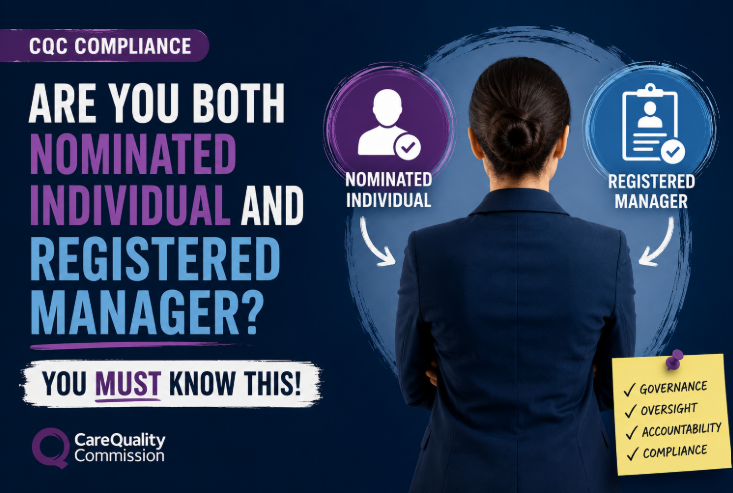
When the Nominated Individual and Registered Manager Are the Same Person: The CQC Oversight Test You Cannot Skip
Every month we sit down with someone preparing to apply to the Care Quality Commission and within ten minutes of opening their draft application we have the same conversation, about being both nominated individual and registered manager. They are the sole director of the company. They will be the Nominated Individual. They will be the Registered Manager. They will be the Designated Safeguarding Lead. And they have not understood that this concentration of roles is precisely what CQC will probe hardest.
The Health and Social Care Act and the 2014 Regulations do not prohibit one person from holding all of these positions. CQC accepts this arrangement routinely, particularly in small domiciliary care, supported living and single-site care home applications. What CQC will not accept is an applicant who has not thought through what it means.
If you are preparing an application now, or you have been queried after submission, this is the gap you need to close.
Why the nominated individual and registered manager question comes up so often
Small adult social care providers are usually launched by one experienced practitioner who has worked their way up through the sector, frontline worker, senior carer, coordinator, manager. They form a limited company, become its sole director, apply to be the Nominated Individual under Regulation 6, apply to be the Registered Manager under Regulation 7, and step into the Designated Safeguarding Lead role on day one. Many also act as their own Infection Prevention and Control Lead.
This is sensible commercially. A second senior salary before you have any clients is unaffordable. The difficulty is that the regulatory framework assumes a level of separation of duties that does not exist in a one-person operation, and CQC’s job at the registration stage is to make sure you have built that separation externally before they hand you a certificate.
What CQC is actually testing for
Regulations 5, 6, 7 and 17, read together, require a registered provider to demonstrate independent oversight of its leadership. This is not the same as having a good policy. It is a structural arrangement that allows someone outside the person being scrutinised to perform four specific functions:
- Conducting the Registered Manager’s annual appraisal
- Providing professional supervision to the Registered Manager
- Receiving and investigating complaints made about the Registered Manager
- Acting as an alternative safeguarding contact when the allegation concerns the Designated Safeguarding Lead
When the Nominated Individual and Registered Manager are the same person, none of these functions can sit internally. There is no one senior enough inside the organisation to do them. CQC’s assessors are trained to look for the external arrangement that fills the gap, and the absence of one is among the most common reasons we see applications returned, queried or refused.
What goes wrong in real applications
The pattern is depressingly consistent. The application form makes the dual role clear. The Statement of Purpose names one person for everything. The Complaints Policy explains how to make a complaint, but when you read it carefully it tells you to address your complaint about the Registered Manager to the Registered Manager. The Safeguarding Policy names a Designated Safeguarding Lead and routes all concerns to that person, including concerns about that person.
CQC reads this and asks the obvious question. What happens if the concern is about the manager themselves? The application does not answer.
We have also seen applications that try to fudge this with vague wording, “complaints about the Registered Manager will be handled independently”, without naming who, how, or on what authority. That phrasing fails the test. CQC wants a named arrangement, in writing, in place at the point of submission. Aspirational language about future arrangements is not enough.
The four functions you have to cover
It helps to think of independent oversight as four distinct functions, each of which needs an answer.
Supervision. The Registered Manager needs regular professional supervision from someone qualified to provide it. For a sole director this cannot be a member of their own staff. It must come from outside the organisation.
Appraisal. A documented annual review of the Registered Manager’s performance against their role and against the regulatory requirements. CQC will ask to see the most recent one at inspection.
Complaints handling. A named individual or organisation, independent of the provider, who will receive and investigate any complaint made about the Registered Manager. This person must be named in the Complaints Policy, with contact details, before the policy is submitted. A placeholder will fail.
Safeguarding alternative contact. When the Designated Safeguarding Lead is also the person about whom a safeguarding concern is being raised, staff, service users and families must have a route that bypasses them entirely. The Care Quality Commission, the Local Authority safeguarding team and the police are part of this picture, but a named individual contact is also expected.
The good news is that one well-chosen arrangement can cover all four. That is the most cost-effective route for a small provider, and it is also the cleanest answer for CQC.
Practical routes to put this in place
There are several credible options. Most providers combine two of them.
Skills for Care Registered Manager membership and mentoring is the strongest signal. Membership pairs the Registered Manager with an experienced mentor from another provider, builds them into the national Registered Manager network, and produces meeting records that evidence supervision. Inspectors recognise the affiliation immediately and it costs less than fifty pounds a year. It is the single highest-credibility, lowest-cost step you can take.
A retained independent Registered Manager from another CQC-registered provider is the most flexible answer. A short Memorandum of Understanding sets out monthly supervision, annual appraisal, the complaints handler role and the safeguarding alternative-contact role. The independent Registered Manager needs the right credentials, a current registration, ideally a Good or Outstanding inspection history, and an Enhanced DBS check, and a modest retainer. Expect to pay between £1,500 and £3,500 a year for a small provider.
Specialist care-sector consultancies offer the same functions as a paid managed service. They will typically include quarterly mock inspections and a structured audit cycle. Cost is higher, but the package is broader.
A Non-Executive Director or external advisor appointed through Companies House works well for the governance and appraisal functions. It does not replace a CQC-experienced safeguarding contact unless the individual has the right background.
The Local Authority Provider Quality team in your borough is a free supplementary route. They will not act as your supervisor, but they can be named in the safeguarding policy as a confirmed escalation route. It strengthens the application without adding cost.
How to evidence it
Whichever route is chosen, CQC expects four things to be present in the application pack and on the shelf at first inspection.
First, a signed written agreement, a Memorandum of Understanding, Service Level Agreement or contract, setting out who the independent person is, their credentials, the functions they will perform and the frequency of contact.
Second, a clear schedule showing when supervision and appraisal will happen across the year.
Third, the independent person’s own evidence of fitness, their CV, professional registration, Enhanced DBS where relevant, and proof of their employer’s good standing with CQC.
Fourth, by the time of the first inspection, completed records showing that supervision actually happened. Paper without practice is not enough. CQC’s inspectors will ask to see them.
The straightforward fix when you are nominated individual and registered manager
If you are preparing an application and you have not yet built this arrangement, do it before you submit. It is far easier than fixing it after a rejection or a Section 60 notice.
The single most useful early step is to identify the independent Registered Manager you intend to retain and put a one-page Memorandum of Understanding in place. That document, attached to the application or referenced in your Complaints Policy, Safeguarding Policy and Governance Policy, transforms the application from “concentrated risk” to “concentrated authority with structural oversight”, and that is exactly what CQC wants to see.
Where Cura comes in
We draft these arrangements as part of every CQC registration we support. We have a network of experienced Registered Managers who act as independent oversight contacts for our clients, and we maintain template Memoranda of Understanding that have been tested against CQC’s current registration assessment.
If you are about to apply, or your application has been queried on this point, get in touch. The fix is usually quicker than people expect, and it is often the difference between a registration that proceeds cleanly and one that bounces back.
This article is part of Cura’s CQC Registration Insights series, drawing on patterns we see week to week in supporting adult social care providers into registration.