
CQC registration for your ambulance service, made simple
Any service in England that carries patients in a vehicle built or adapted for people who need treatment must register with CQC before its first journey, for transport services, triage and medical advice provided remotely, and usually for treatment of disease, disorder or injury too if your crews treat. For CQC registration of your ambulance service, we prepare your applications, the ambulance documents CQC now requires and your interview preparation from £1,795, then stay with you until CQC makes its decision.
Who needs CQC registration for an ambulance service
Transport services, triage and medical advice provided remotely is a regulated activity when you carry people who need treatment in a vehicle designed for that purpose, and that includes air and water ambulances. CQC counts a vehicle built for the job or modified for it, but livery on its own does not make a vehicle an ambulance. Providing the activity in England without registration is an offence under section 10 of the Health and Social Care Act 2008.
Transport does not cover what your crews do for the patient. If registered paramedics, nurses or doctors treat people on the journey, or supervise the staff who do, you also need treatment of disease, disorder or injury. Emergency intubation, chest drains and tracheotomy then count as treatment rather than surgical procedures, as long as your Statement of Purpose says you carry them out. ECGs, defibrillation, pulse oximetry and blood pressure checks need no diagnostic and screening registration alongside transport.
Read the legal definition (Regulated Activities Regulations 2014, Schedule 1, paragraph 9)Event medical services: the 2026 change
The exceptions for treatment at sports grounds, gyms and sporting or cultural events were removed by the Regulated Activities (Amendment) Regulations 2026. CQC has taken applications since 7 September 2026, and from 6 December 2027 treating at an event without registration is an offence. CQC says it will take all reasonable steps to decide complete applications received by 1 March 2027 before then. Read our guide for event medical providers
New ambulance documents from 17 August 2026
Applications submitted after 17 August 2026 must include eleven ambulance documents and the additional form for ambulance services, plus three clinical documents if you apply for treatment. CQC rejects an application with a required document missing, and a resubmission counts as a new application that loses its place in the queue. Read our guide to the 2026 document rules
Needs CQC registration
- Non-emergency patient transport to a healthcare setting
- Emergency ambulance services
- Secure mental health transport, including people detained under the Mental Health Act
- Air ambulances where the provider’s own clinicians, such as a doctor, treat patients
- Event medical crews taking a patient off the event site to hospital
- Ambulance control centres that triage calls by phone
Outside this activity
- Taxis, volunteer cars, mortuary vehicles and Dial-A-Ride, even if the DVLA lists them as ambulances
- Moving a patient within the boundary of a sporting or cultural event site
- Medical repatriation arranged only under a travel insurance policy
- An air ambulance operator that supplies only the aircraft and flight crew and gives no treatment
- Transport of blood, tissue and organs
- Search and rescue transport arranged by a government department
Everything you need for CQC registration of an ambulance service
Written for your vehicles, crews and clinical model, not a template pack. Stage 1 covers every document CQC needs with your application, then Stage 2 carries you through assessment and the interview.
Your application pack
Required from every provider
- Statement of Purpose
- Safeguarding policy and procedure
- Medicines management policy, including transporting patient medication
- Infection prevention and control policy
- Recruitment policy
- Complaints policy
- Consent policy and procedure
- Equality, diversity and human rights policy
- Governance and quality assurance policies
- Financial viability statement guidance, completed with your accountant where CQC needs one
Extra for ambulance services, from 17 August 2026
- Vehicle details: your ownership or lease evidence, equipment list and photographs, put together with you
- Bariatric patient policy
- Incident reporting policy
- Medical emergency policy, covering the emergency medicines and equipment you carry
- Restraint policy
- Staffing structure
- Staff training plan
- Fire, health and safety, and Legionella risk assessments
- Business plan with a 12-month monthly financial forecast
- Provider and registered manager forms, plus the additional form for ambulance services, completed with you
If your crews treat patients
- Patient Group Directions for each medicine that needs one, ready for signing
- Major incidents policy
- Clinical pathways for each condition you treat
Assessment, interview and follow-up
- Booking and waste management policies, which CQC asks you to have ready
- Records management, procurement and data protection documents, and your self-audit process
- Registered manager interview question and answer pack
- Two-hour mock interview with written feedback
- Follow-up with CQC on your behalf until a decision is made
- Appeal support if your application is challenged
What an ambulance application has to prove
The evidence CQC looks at closely in an ambulance application, so we make sure each piece is in place before you submit.
A vehicle CQC can assess
CQC wants evidence that you own or lease the vehicle, its equipment list, and photographs of the vehicle and your base. It says that if the vehicle requirements are not met, it may be unable to continue assessing your application, so we build this part with you first.
Medicines your crews can lawfully give
Registered paramedics can give a set list of prescription only medicines by injection or infusion, such as adrenaline, morphine sulphate and naloxone, for immediate necessary treatment under Schedule 17 of the Human Medicines Regulations 2012. CQC wants a copy of every Patient Group Direction you use, with medicines that do not need one kept in a separate document such as a formulary.
A Home Office licence for controlled drugs
Home Office guidance says private paramedic and ambulance services should expect to need a licence to hold and supply stocks of controlled drugs such as morphine. CQC tells you to apply as soon as possible, because once a valid application is accepted the Home Office may take up to 16 weeks to contact you about a compliance visit.
Crews that match your paperwork
For CQC purposes a paramedic means someone on the Health and Care Professions Council register. Ambulance care assistants, emergency care assistants and first responders are not on the list of health care professionals, so your staffing structure, pathways and Statement of Purpose must reflect who is actually on each vehicle.
Restraint and mental health transport
Your restraint policy has to define physical, mechanical, chemical and environmental restraint, show it is a last resort, and cover consent and best interests decisions under the Mental Capacity Act 2005. If you carry people detained under the Mental Health Act, your staff training plan must also show restraint training.
A business plan with monthly figures
Ambulance applicants send a business plan with a 12-month forecast set out month by month, with income and itemised costs. Where you also need a financial viability statement, it must be signed by a qualified accountancy firm or an FCA-regulated bank, not a friend or relative.
Five steps from first call to certificate
Our part is fast. CQC’s assessment sets the overall timescale, and we stay with you through it.
Scoping and onboarding
We map your vehicles, crews, base and clinical model and confirm your regulated activities, then give you a checklist of what only you can get: DBS checks, the lease and landlord consent, vehicle purchase or lease papers, insurance quotes, ICO registration and financial evidence.
Stage 1 pack
Your policies, ambulance documents, risk assessments, business plan and forms, written for your service as soon as your requirements are met.
Submission
We check every document against CQC’s list, then support the provider and registered manager applications, sent together as CQC requires.
Stage 2 support
Requested documents, the interview pack, a two-hour mock interview with written feedback, and follow-up with CQC on your behalf.
Decision
You receive your certificate of registration and can then begin operating.
One package, paid in two halves
Our fee covers both stages. The regulator’s fee and your set-up costs are separate, so budget for them too.
CQC registration package
Or pay in full and take 10% off.
Also budget for
Paid to others, not to us. CQC itself charges no application fee, as its annual fee covers initial registration.
- CQC annual fee, charged once you are registered
- Vehicle purchase or lease, equipment and maintenance
- Public and employer’s liability insurance
- DBS checks for your registered manager and crews
- A Home Office controlled drugs licence, if you will hold controlled drugs
- ICO data protection fee
- Your accountant’s time on the financial viability statement, if you need one
If CQC rejects or returns your application before it reaches an inspector, we fix it and resubmit at no extra cost, as many times as it takes. Subject to our terms and conditions.
Buy single documents instead
Statement of Purpose
A Statement of Purpose written for your service, with your provider, location, manager and regulated activity details.
Registered manager interview prep
Practice questions, answer guidance and feedback for the CQC registered manager interview, on its own.
Business continuity plan
An editable plan template covering staffing, premises, utilities, IT, medicines and suppliers, with recovery and review records.
CQC registration for ambulance services: your questions
Do I need CQC registration for a patient transport service?
Do event medical providers now need to register with CQC?
What documents does an ambulance application need in 2026?
Can our paramedics give medicines without a prescription?
Does an air ambulance need to register with CQC?
How long does CQC registration take, and what does it cost?
Guides for ambulance and event medical providers
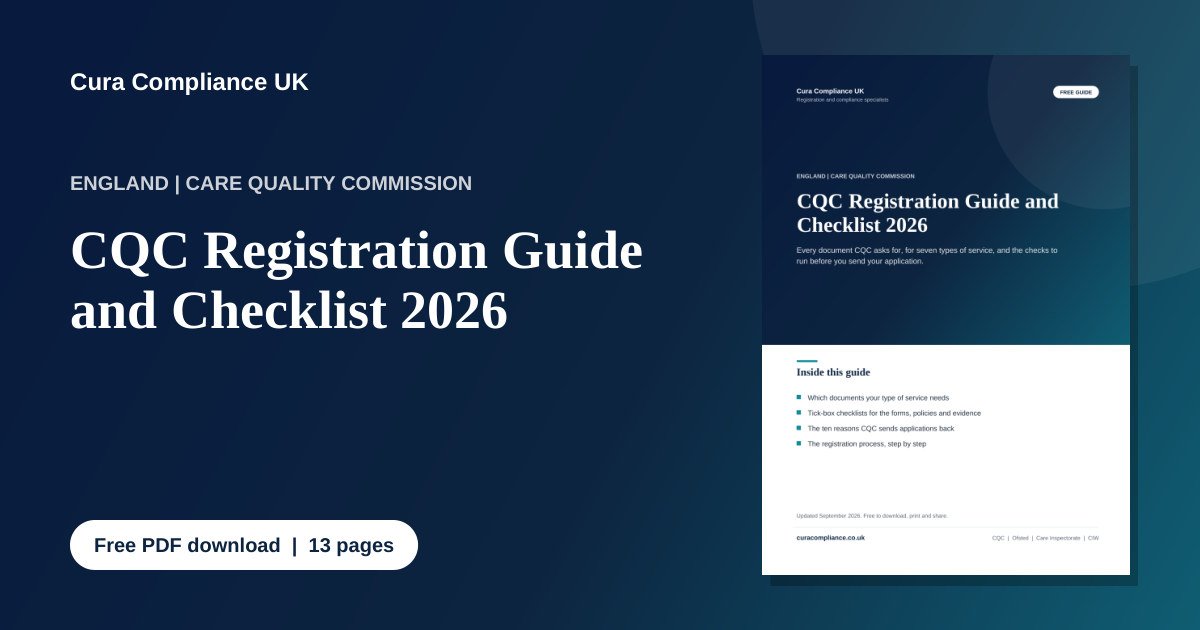
Free CQC registration guide and checklist
A 13-page PDF covering seven types of service, ambulance services among them. It lists the documents each one needs, including the extra ambulance documents, and the checks to run before you apply.
Get the free guideThe words you will meet in your application
Ready to register your ambulance service?
No obligation. We confirm the regulated activities your vehicles and crews need and what you still have to get, as well as a realistic timeline for CQC registration of your ambulance service.