
CQC registration for your IV therapy service, made simple
CQC treats IV vitamin and hydration drips given by a doctor, nurse or other listed professional as treatment of disease, disorder or injury, so an IV clinic or mobile drip service in England must register before its first infusion. For CQC registration of your IV therapy service, we prepare your applications, policies and interview from £1,995, then stay with you until CQC makes its decision.
When an IV drip service needs CQC registration
CQC’s scope guidance says that giving vitamins, or products that are prescription only medicines, including 0.9% saline, into a vein to improve or enhance wellbeing is treatment of a disease or disorder. You need to register for treatment of disease, disorder or injury when your drips are given by, or under the supervision of, a listed health care professional, use a product that is prescription only or needs a prescription when given intravenously, and claim to alter a person’s physiological state in response to a defined concern. CQC does not count it as alternative or complementary medicine.
Most IV services meet the professional test for a simple reason. Under the Human Medicines Regulations 2012, a prescription only medicine can only be injected by a doctor, dentist or other prescriber the law recognises, or by someone acting on their directions, such as a nurse giving a drip a doctor has prescribed. Providing a regulated activity without registration is an offence under section 10 of the Health and Social Care Act 2008, and the exception for doctors in private practice never covers IV medicines.
Read CQC’s scope of registration guidance, which covers IV productsMobile and home visit drips
A mobile service registers in the same way. Your Statement of Purpose gives the location the service is run from and describes where treatment happens, and your insurance should name IV therapy and treatment away from that base. The same infection control and emergency standards apply in a patient’s home as in a clinic.
Nurse-led clinics
A nurse who is an independent prescriber can prescribe and give drips. A nurse who is not needs a doctor or other prescriber to direct each patient’s treatment, or a patient group direction once you are registered. Either way the service is in scope, because nurses are on CQC’s list of health care professionals.
Needs CQC registration
- IV vitamin, mineral or hydration drips given by a nurse, paramedic or doctor
- Drips using 0.9% saline or another prescription only product, sold for wellbeing
- Mobile and home visit IV services run by a listed health care professional
- Vitamin injections, such as B12, prescribed or given by a listed health care professional
- IV medicines given by a doctor in private practice, as the consulting room exception never covers them
Outside this activity, or covered by treatment
- Blood samples taken before a drip, once you are registered for treatment
- A standalone service where only a pharmacist treats, as pharmacists are not on CQC’s list
- Non-medical add-ons, such as a sauna, run by staff who are not health care professionals and sold without treatment claims
Everything you need for CQC registration of an IV therapy service
Written for your service, not a template pack. Stage 1 gets your application in, then Stage 2 carries you through assessment and the interview.
Your application pack
Your Statement of Purpose and policies
- Statement of Purpose, setting out your drips, your prescribers and where you treat
- Medicines management and prescribing policy, written for IV products and including transportation of patient medication
- Infection prevention and control policy, written for cannulation and infusions
- Safeguarding policy and procedure
- Consent policy and procedure
- Recruitment policy
- Complaints policy
- Equality, diversity and human rights policy
- Governance and quality assurance policies
Forms and finance
- Provider and registered manager application forms, completed with you
- Financial viability statement guidance, completed with your accountant (most clinic applicants need one)
Assessment, interview and follow-up
- Documents CQC may ask for during assessment, prepared and kept ready: business continuity plan, freedom to speak up policy, health and safety risk assessment, list of risk assessments, medical emergency policy, significant events policy, staff training matrix and staffing structure
- Registered manager interview question and answer pack
- Two-hour mock interview with written feedback
- Follow-up with CQC on your behalf until a decision is made
- Appeal support if your application is challenged
What an IV therapy service has to prove
The extra evidence an IV application needs, from who prescribes each drip to what happens if a patient reacts, so we make sure each piece is in place before you submit.
A prescriber behind every drip
A prescription only medicine can only be injected by a doctor, dentist or other prescriber the law recognises, or by someone acting on their directions. Your medicines policy names your prescribers, sets out how they assess each patient before a drip is prescribed, and shows how a nurse who is not a prescriber receives those directions.
Patient group directions come later
An independent clinic in England can use a patient group direction only once its provider is registered with CQC, signed for the provider and by the registered manager. A PGD also covers licensed medicines only, so any unlicensed product needs a prescriber’s direction for the named patient.
Unlicensed products and specials
GMC guidance says doctors should usually prescribe licensed medicines, and use an unlicensed one only where it is needed to meet the patient’s specific needs, taking responsibility for monitoring and follow-up. A special can only be made to a prescriber’s specification for a patient they are directly responsible for, and nobody may advertise it.
Anaphylaxis and the emergency kit
Resuscitation Council UK’s anaphylaxis algorithm starts with calling for help and stopping the infusion, then intramuscular adrenaline at 1 mg/mL, 500 micrograms for an adult, repeated after five minutes if there is no response. Every session, in the clinic or a patient’s home, needs that kit and staff trained to use it.
Telling the patient’s GP
GMC guidance asks prescribers who are not the patient’s GP to seek consent to share information with the GP when the episode of care ends. CQC has challenged IV services that left this to the patient, because an infusion the GP does not know about can mislead later blood results. Set up a secure way to send it before your interview.
Advertising within the law
The Human Medicines Regulations ban advertising that is likely to lead to the use of a prescription only medicine, and the ASA says prescription only IVs and vitamin injections cannot be advertised to the public. Medicinal claims are not allowed unless the product is licensed for that purpose, and your website should describe the same services as your application.
Five steps from first call to certificate
Our part is fast. CQC’s assessment sets the overall timescale, and we stay with you through it.
Scoping and onboarding
We map your drips, prescribers, staff and where you treat, confirm your regulated activity, then give you a checklist of what only you can get: DBS checks, the lease and landlord consent, insurance that names IV therapy, ICO registration and financial evidence.
Stage 1 pack
Your Statement of Purpose, medicines and prescribing policy, infection control policy and forms, as soon as your requirements are met.
Submission
We check everything first, then support you to send the provider and registered manager applications to CQC.
Stage 2 support
The documents CQC may request, including your medical emergency policy, the interview pack, a two-hour mock interview with written feedback, and follow-up with CQC.
Decision
You receive your certificate of registration and can then give your first infusion.
One package, paid in two halves
Our fee covers both stages. The regulator’s fee and your set-up costs are separate, so budget for them too.
CQC registration package
Or pay in full and take 10% off.
Also budget for
Paid to others, not to us. CQC itself charges no application fee.
- CQC annual fee, charged once you are registered
- Medical indemnity and liability insurance that name IV therapy, and home visits if you offer them
- DBS checks
- ICO data protection fee
- Emergency drugs and equipment for every session
- Safety certificates for your clinic premises, if you have one
If CQC rejects or returns your application before it reaches an inspector, we fix it and resubmit at no extra cost, as many times as it takes. Subject to our terms and conditions.
Buy single documents instead
Statement of Purpose
A Statement of Purpose written for your service, with your provider, location, manager and regulated activity details.
Registered manager interview prep
Practice questions, answer guidance and feedback for the CQC registered manager interview, on its own.
Health and safety log books for clinics
Editable logs for premises checks, maintenance, cleaning, fire safety and incidents, so your records are in order before the site visit.
CQC registration for IV therapy: your questions
Do wellness IV drips really need CQC registration?
Can a nurse run an IV clinic without a doctor?
Can we offer drips in patients’ homes or at events?
Can we use patient group directions instead of prescriptions?
Can we advertise our drips on social media?
How long does CQC registration for IV therapy take, and what does it cost?
Guides for IV therapy providers
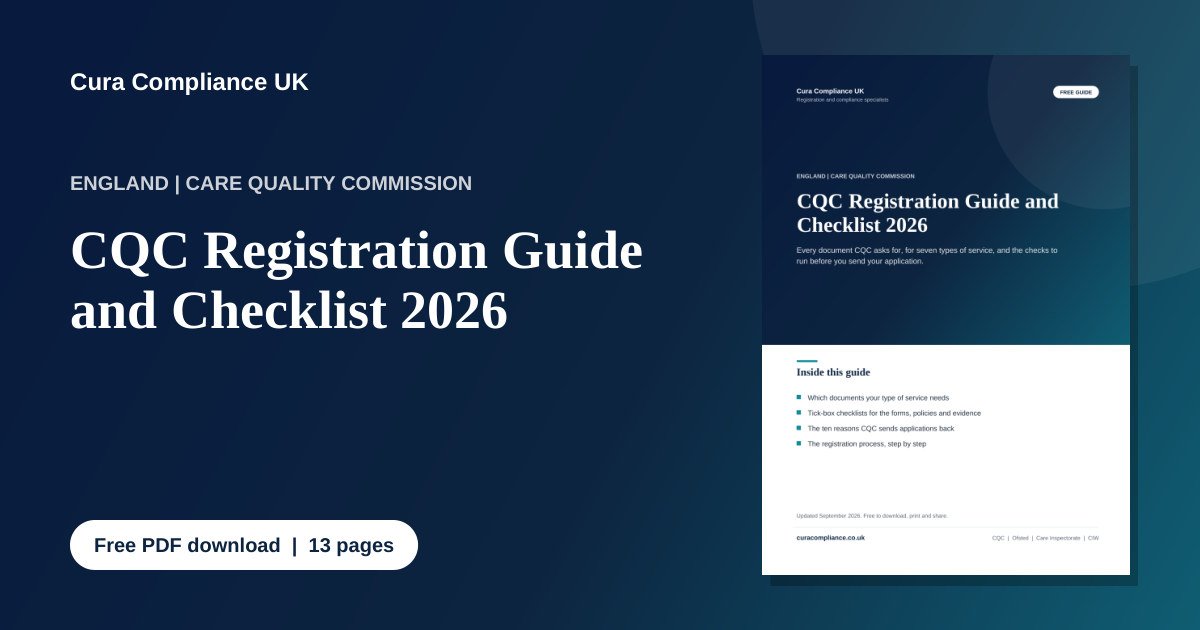
Free CQC registration guide and checklist
A 13-page PDF covering GP practices, online GP services and five other types of service. It lists the core policies every applicant sends and the checks to run before you apply.
Get the free guideThe words you will meet in your application
Ready to register your IV therapy service?
No obligation. We confirm what CQC registration will need from your IV service, who should prescribe and what you still have to get, as well as a realistic timeline.