
CQC registration for your aesthetics clinic, made simple
An aesthetics clinic in England needs CQC registration when a doctor, nurse or other health care professional treats a medical condition or carries out cosmetic surgery such as a thread lift, while Botox and fillers given purely to improve appearance are not regulated on their own. For CQC registration of your aesthetics clinic, we confirm which treatments are in scope, then prepare your applications, policies and interview from £1,995 and stay with you until CQC makes its decision.
Which aesthetics treatments need CQC registration
Registration depends on the treatments you offer and who carries them out. Cosmetic surgery is a regulated activity when a health care professional performs a procedure that inserts instruments or equipment into the body, and the government lists all types of thread lift, liposuction including laser lipolysis, implants and eyelid surgery among them. Treating a medical condition is regulated too when a doctor, nurse or other listed health care professional provides or supervises it. Providing either without registration is an offence under section 10 of the Health and Social Care Act 2008.
Botulinum toxin and dermal fillers given purely to improve appearance are not regulated activities on their own. The law excepts subcutaneous injection to enhance appearance from surgical procedures, and CQC’s guidance says treatment does not include interventions carried out purely for cosmetic purposes. However, if a doctor or nurse uses botulinum toxin to treat a condition, such as excessive underarm sweating, that is treatment and needs registration.
Non-surgical lasers and IPL left CQC registration in October 2010. CQC now says a laser or IPL service delivered by listed health care professionals needs registration only where their clinical skills are used, where it is combined with procedures that need their qualification, such as prescribing, or where you describe it as given by a registered health care professional.
Read the legal definitions (Regulated Activities Regulations 2014, Schedule 1)The licensing scheme is not in force yet
The Health and Care Act 2022 lets the government license non-surgical procedures such as Botox and fillers through local councils, and it says it remains committed to doing so. Separately, it is consulting until 13 January 2027 on making high-risk procedures, such as deep chemical peels and some laser treatments, CQC regulated and limited to named health care professionals.
Under 18s
It is an offence in England to give botulinum toxin, or a filler injection for a cosmetic purpose, to anyone under 18. The defences are narrow: a doctor gives it, a nurse, dentist or pharmacist gives it on a doctor’s directions, or you took reasonable steps to check age. If you treat adults only, check photo ID and write that step into your consent policy.
Needs CQC registration
- Thread lifts of any type, including PDO and PLLA threads
- Liposuction, including laser lipolysis through a cannula
- Breast, eyelid, nose and other cosmetic surgery, and any procedure using an implant
- Botulinum toxin or other treatment for a medical condition, given by a doctor or nurse
- Cutting out moles, cysts or other skin lesions with a scalpel
- Removing tissue, such as a biopsy, to find out whether there is disease
Not regulated on its own
- Botulinum toxin and dermal fillers given purely to improve appearance
- Cosmetic laser and IPL treatments, unless one of CQC’s three conditions applies
- Piercing, tattooing, and removing hair roots or small blemishes with heat from an electric current
- Ultrasound or other energy applied to the skin, with no incision or anything inserted
Everything you need for CQC registration of an aesthetics clinic
Written for your clinic and the treatments you actually provide, not a template pack. Stage 1 gets your application in, then Stage 2 carries you through assessment and the interview.
Your application pack
Required from every provider
- Statement of Purpose
- Safeguarding policy and procedure
- Medicines management and prescribing policy, including transportation of patient medication
- Infection prevention and control policy
- Recruitment policy
- Complaints policy
- Consent policy and procedure
- Equality, diversity and human rights policy
- Governance and quality assurance policies
Forms and financial evidence
- Financial viability statement guidance, completed with your accountant
- Provider and registered manager application forms, completed with you
Assessment, interview and follow-up
- The eight documents CQC tells clinics to keep ready: business continuity plan, freedom to speak up policy, health and safety risk assessment, list of risk assessments, medical emergency policy, significant events policy, staff training matrix and staffing structure
- Registered manager interview question and answer pack
- Two-hour mock interview with written feedback
- Follow-up with CQC on your behalf until a decision is made
- Appeal support if your application is challenged
What CQC looks for in an aesthetics clinic
The points that decide most aesthetics and cosmetic clinic applications, so we make sure each one is settled before you submit.
One account of your treatments
Your forms, Statement of Purpose and policies must describe the same treatments and the same age range. We list your purely cosmetic treatments in a separate, clearly non-regulated section, and you should check your website says the same before you apply.
Botulinum toxin prescribed face to face
Botulinum toxin is a prescription-only medicine. GMC guidance says doctors must physically examine the patient before prescribing injectable cosmetic medicines such as Botox, and must not prescribe them remotely. Since June 2025 the NMC has required nurse and midwife prescribers to consult face to face as well.
Who prescribes, holds and gives medicines
The NMC notes that only doctors and dentists may hold prescription-only medicines as stock, so a nurse prescriber uses a patient specific direction. Your medicines policy has to say who prescribes, who injects, how medicines are obtained and stored, and how you check anyone you delegate to.
A treatment room that matches the policy
CQC’s assessment can include a site visit, and you must assess and control the risk of infection. Expect questions about your hand-wash basin, wipeable couch, single-use items, sharps, cleaning schedule and where the emergency kit is kept, so your infection control policy describes the real room.
Complaints with an independent final stage
The Parliamentary and Health Service Ombudsman cannot look into complaints about privately funded healthcare. Your complaints policy, and the poster in your clinic, should therefore name the independent adjudication service you have actually joined, not the ombudsman.
Evidence for every treatment you list
Keep training certificates, logbooks and competence records for each procedure your clinicians perform, ready to send. If you treat skin lesions, also expect to be asked how you tell a harmless lesion from one that needs referral.
Five steps from first call to certificate
Our part is fast. CQC’s assessment sets the overall timescale, and we stay with you through it.
Scoping and onboarding
We go through every treatment you offer and confirm your regulated activities, then give you a checklist of what only you can get: DBS checks, your lease and landlord consent, insurance and indemnity, ICO registration and financial evidence.
Stage 1 pack
Your policies and Statement of Purpose written for the treatments you actually provide, with your forms completed with you, as soon as your requirements are met.
Submission
We check everything first, then support you to send the provider and registered manager applications to CQC.
Stage 2 support
The documents CQC may ask for, the interview pack, a two-hour mock interview with written feedback, and follow-up with CQC on your behalf.
Decision
You receive your certificate of registration and can then begin providing your regulated treatments.
One package, paid in two halves
Our fee covers both stages. The regulator’s fee and your set-up costs are separate, so budget for them too.
CQC registration package
Or pay in full and take 10% off.
Also budget for
Paid to others, not to us. CQC itself charges no application fee.
- CQC annual fee, charged once you are registered
- Medical indemnity for each clinician, covering every treatment they give
- Public and employer’s liability insurance
- DBS checks
- ICO data protection fee
- Premises safety checks, such as a fire risk assessment and electrical safety certificate
- A council licence for laser or skin treatments, where your council requires one
If CQC rejects or returns your application before it reaches an inspector, we fix it and resubmit at no extra cost, as many times as it takes. Subject to our terms and conditions.
Buy single documents instead
Cosmetic clinic policy set
The full set of editable policies for aesthetic and cosmetic clinics, covering consent, safeguarding, infection prevention and governance, if you are writing the application yourself.
Statement of Purpose
A Statement of Purpose written for your clinic, with your provider, location, manager and regulated activity details.
Registered manager interview prep
Practice questions, answer guidance and feedback for the CQC registered manager interview, on its own.
Keep your policies current
CuraFlow Policies keeps your full library up to date with law and CQC changes once you are registered.
CQC registration for an aesthetics clinic: your questions
Do I need CQC registration to offer Botox and fillers?
Do I need CQC registration for laser hair removal or IPL?
Which regulated activities does an aesthetics clinic usually need?
Can a nurse-led aesthetics clinic register, and who is the registered manager?
Will the new rules on high-risk cosmetic procedures affect my clinic?
How long does CQC registration take for an aesthetics clinic, and what does it cost?
Guides for aesthetics clinic providers
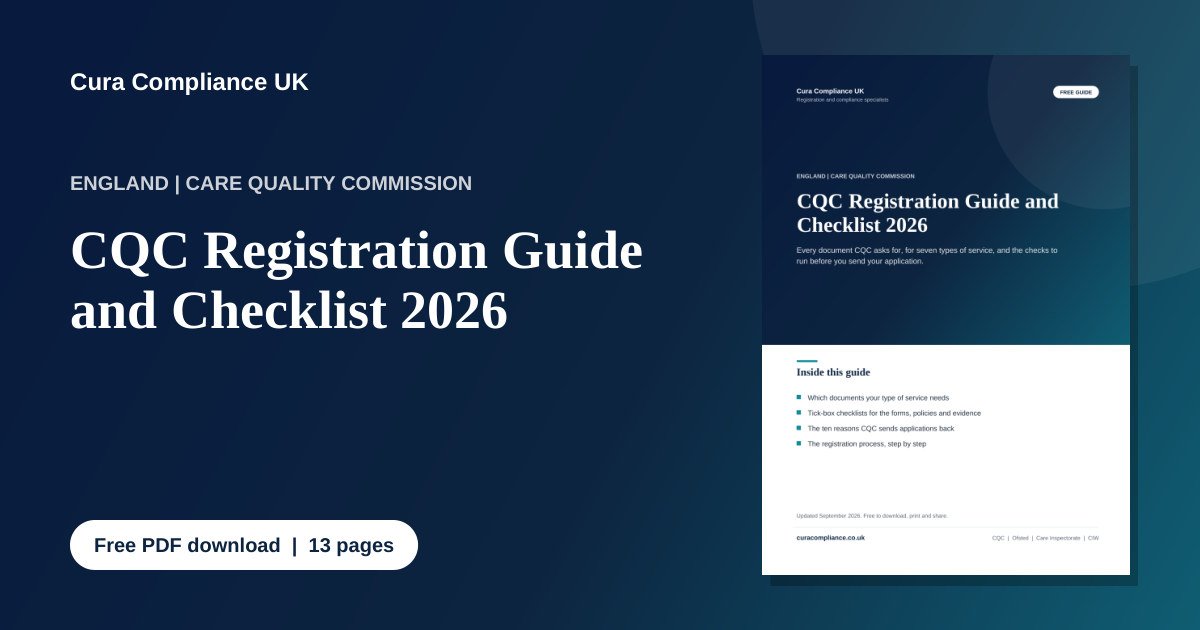
Free CQC registration guide and checklist
A 13-page PDF covering home care, supported living, online GP services and four other types of service. It lists the documents each one needs and the checks to run before you apply.
Get the free guideThe words you will meet in your application
Ready to register your aesthetics clinic?
No obligation. We go through your treatment list and confirm which regulated activities apply and what you still have to get, as well as a realistic timeline for CQC registration of your aesthetics clinic.