
CQC registration for your ADHD clinic, made simple
An ADHD service in England must register with CQC before it treats anyone, for example by prescribing, titrating or reviewing medication, in a clinic or online. CQC says a service that only diagnoses ADHD does not need to register, so we confirm your scope first, then prepare your applications, controlled drugs and prescribing policies and interview from £1,995 for an in-person clinic, with a separate online package.
Does an ADHD clinic need CQC registration?
Treatment of disease, disorder or injury is a regulated activity when it is provided by, or under the supervision of, a doctor, nurse or other listed health care professional, or a team that includes one. For an ADHD service that covers prescribing, titrating and reviewing medication, whether you see patients in a clinic or online. Providing it without registration is an offence under section 10 of the Health and Social Care Act 2008.
Diagnosis on its own is treated differently. CQC’s scope guidance says it does not consider diagnosing ADHD or autism to be treatment, so a service that only assesses and diagnoses, with no treatment of any kind, does not need to register for it. Nor is the assessment a diagnostic and screening procedure, because it uses no equipment to measure physiological data.
Read CQC’s scope guidance for treatment of disease, disorder or injuryDiagnosis now, treatment later?
A service that diagnoses and refers on does not need to register. Adding titration, prescribing or medication reviews later brings in treatment of disease, disorder or injury, and you must be registered before that work starts. Where a case is unclear, CQC says it considers it individually.
Psychiatrist, nurse or psychologist?
Scope turns on who treats. Treatment by a psychiatrist, GP or nurse is in scope, and so is treatment by a team that includes one. Clinical psychologists are not on the list of health care professionals, so a standalone treatment service run only by psychologists does not need this activity.
Needs CQC registration
- Prescribing ADHD medication after diagnosis, in a clinic or online
- Titration: adjusting the dose until it is stable
- Medication reviews and monitoring of pulse, blood pressure and weight
- Nurse-led ADHD treatment, including nurse prescribers
- Assessment and diagnosis offered together with any treatment
- Treatment for coexisting conditions by a doctor or nurse
Not regulated on its own
- Assessment and diagnosis only, with no treatment of any kind
- Treatment by clinical psychologists working alone, with no listed professional in the team
- ADHD coaching by coaches who are not listed health care professionals
- Support from occupational therapists or other unlisted professionals working alone
Everything you need for CQC registration of an ADHD clinic
Written for your service, not a template pack. Stage 1 gets your application in, then Stage 2 carries you through assessment and the interview.
Your application pack
Required from every provider
- Statement of Purpose
- Safeguarding policy and procedure
- Medicines management and prescribing policy, including controlled drugs and transporting patient medication
- Infection prevention and control policy
- Recruitment policy
- Complaints policy
- Consent policy and procedure
- Equality, diversity and human rights policy
- Governance and quality assurance policies
Extra for clinics
- Financial viability statement guidance, completed with your accountant, where CQC needs one
- Provider and registered manager forms, completed with you
Extra if you work online
- Inclusion and exclusion criteria policy, setting out who you will and will not treat
- Medical emergency policy
- The additional form for online primary care providers, completed with you
Assessment, interview and follow-up
- Additional documents CQC may ask for during assessment, prepared and kept ready
- For a doctor-led clinic: business continuity plan, freedom to speak up policy, significant events policy, medical emergency policy, risk assessments, staff training matrix and staffing structure
- Registered manager interview question and answer pack
- Two-hour mock interview with written feedback
- Follow-up with CQC on your behalf until a decision is made
- Appeal support if your application is challenged
What an ADHD service has to prove
The extra evidence an ADHD application needs, so we make sure each piece is in place before you submit.
Controlled drugs, prescribed lawfully
Stimulants such as methylphenidate and lisdexamfetamine are Schedule 2 controlled drugs. A private prescription for one must be written on the standard private prescription form and show your prescriber identification number, and CQC expects your medicines policy to set out your approach to controlled drugs.
Diagnosis to the NICE standard
NICE guideline NG87 says ADHD should only be diagnosed by a specialist psychiatrist, paediatrician or other appropriately qualified healthcare professional with training and expertise in ADHD, after a full clinical and psychosocial assessment, and never on rating scales alone. Your pathway and training records need to show this.
Titration and monitoring
Before medication starts, NICE expects a baseline review that includes pulse, blood pressure, height, weight, a cardiovascular assessment and a risk assessment for substance misuse and diversion. Pulse and blood pressure are checked after each dose change and every 6 months, so an online service must say how those readings reach the prescriber.
Shared care with the patient’s GP
NICE expects prescribing and monitoring to move to a shared care arrangement with primary care once the dose is stable. GMC guidance says shared care needs the agreement of everyone involved, including the patient, so your policy also has to cover what happens when a GP declines.
Records before remote prescribing
GMC guidance says that if you do not have access to relevant information from the patient’s medical records, you must not prescribe controlled drugs, except in narrow circumstances. An online ADHD service therefore needs identity checks, consent to contact the GP and a way to see the record before it prescribes stimulants.
One scope, written the same way
Because an ADHD assessment is not a diagnostic and screening procedure, that activity does not belong on your forms. Your provider form, Statement of Purpose and policies then need to describe the same activities, age groups and medicines, word for word.
Five steps from first call to certificate
Our part is fast. CQC’s assessment sets the overall timescale, and we stay with you through it.
Scoping and onboarding
We map your assessment and treatment pathway, confirm whether and what you need to register, then give you a checklist of what only you can get: DBS checks, indemnity, premises or registered office arrangements, ICO registration and financial evidence.
Stage 1 pack
Your policies written for ADHD care, covering controlled drugs, titration and shared care, plus your forms, as soon as your requirements are met.
Submission
We check everything first, then support you to send the provider and registered manager applications to CQC.
Stage 2 support
Requested documents, the interview pack, a two-hour mock interview with written feedback, and follow-up with CQC on your behalf.
Decision
You receive your certificate of registration and can then begin treating patients.
One package, paid in two halves
Our fee covers both stages. The regulator’s fee and your set-up costs are separate, so budget for them too.
CQC registration package
Or pay in full and take 10% off.
Also budget for
Paid to others, not to us. CQC itself charges no application fee.
- CQC annual fee, charged once you are registered
- Medical indemnity that covers ADHD prescribing, and online work if you offer it
- Public and employer’s liability insurance
- DBS checks
- ICO data protection fee
- Your accountant’s time on the financial viability statement, where CQC needs one
- A Home Office controlled drugs licence, only if your company will hold or supply controlled drugs
If CQC rejects or returns your application before it reaches an inspector, we fix it and resubmit at no extra cost, as many times as it takes. Subject to our terms and conditions.
Buy single documents instead
Statement of Purpose
A Statement of Purpose written for your service, with your provider, location, manager and regulated activity details.
Registered manager interview prep
Practice questions, answer guidance and feedback for the CQC registered manager interview, on its own.
Business continuity plan
An editable plan template covering staffing, premises, utilities, IT, medicines and suppliers, with recovery and review records.
Keep your policies current
CuraFlow Policies keeps your full library up to date with law and CQC changes once you are registered.
CQC registration for an ADHD clinic: your questions
Do I need CQC registration if I only diagnose ADHD?
Does a psychologist-led ADHD service need CQC registration?
Can an online ADHD clinic prescribe stimulants?
Do we need a controlled drugs accountable officer?
How long does CQC registration for an ADHD clinic take, and what does it cost?
What happens if CQC sends my application back?
Guides for ADHD clinic providers
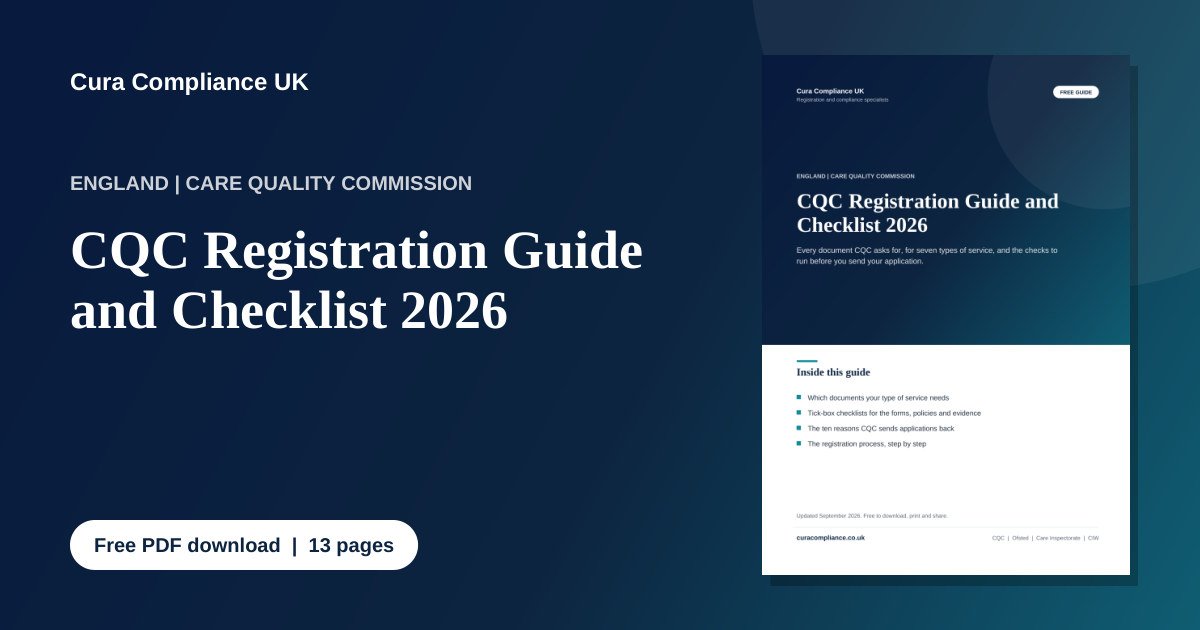
Free CQC registration guide and checklist
A 13-page PDF covering home care, supported living, online GP services and four other types of service. It lists the documents each one needs and the checks to run before you apply.
Get the free guideThe words you will meet in your application
Ready to register your ADHD clinic?
No obligation. We confirm whether your ADHD service needs to register, which regulated activities apply and what you still have to get, as well as a realistic timeline.