
CQC registration for your dental practice or mobile dental service
A dental practice or mobile dental service in England must register with CQC before it treats its first patient, whether NHS or private, usually for treatment of disease, disorder or injury, diagnostic and screening procedures and surgical procedures. For CQC registration of your dental service, we prepare your applications, policies, risk assessments and interview from £1,995, then stay with you until CQC makes its decision.
Who needs CQC registration for a dental service
Treatment of disease, disorder or injury is a regulated activity when it is carried on in England by, or under the supervision of, a health care professional. The legal list includes dentists, dental hygienists, dental therapists, dental nurses, dental technicians and orthodontic therapists registered with the GDC, so a practice, a specialist clinic and a dentist who visits patients at home all need registration, whether the care is NHS or private. Providing it without registration is an offence under section 10 of the Health and Social Care Act 2008.
Most dental services need two more activities. Taking X-rays, and analysing and reporting them, is diagnostic and screening procedures, and CQC’s scope guidance puts intraoral scans under that activity too. Surgical procedures covers surgery by a health care professional to treat disease, disorder or injury, such as extractions.
Read the legal definitions (Regulated Activities Regulations 2014, Schedule 1)NHS or private, the registration is the same
CQC registers the provider and its regulated activities, not the contract. An NHS dental contract is a separate agreement with the NHS commissioner, and CQC’s dental guidance treats contract changes and CQC registration as separate issues.
Mobile and domiciliary dentistry
The location on your application is normally the base the service is run from, and your Statement of Purpose explains where patients are actually treated. A hand-held X-ray unit still needs its CEAT report and HSE registration before you apply.
Needs CQC registration
- General dental practices, whether NHS, private or mixed
- Specialist practices and services led by hygienists or therapists
- Mobile and domiciliary dentistry in people’s homes and care homes
- Dental X-rays, including hand-held units, and intraoral scans
- Extractions and other oral surgery
- Clear aligner treatment, however the treatment is started
Not regulated on its own
- Dental services arranged only by a patient’s employer or a government department
- Dental care provided by the armed forces
- Forensic dental services arranged with a local policing body
- Taking a swab from the mouth, once you are registered for treatment
Everything you need for CQC registration of a dental service
Written for your service, not a template pack. Stage 1 gets your application in, then Stage 2 carries you through assessment and the interview.
Your application pack
Required from every provider
- Statement of Purpose
- Safeguarding policy and procedure, for adults and children
- Medicines management policy, including local anaesthetics and emergency drugs
- Infection prevention and control policy, in line with HTM 01-05
- Recruitment policy, including GDC registration checks
- Complaints policy
- Consent policy and procedure
- Equality, diversity and human rights policy
- Governance and quality assurance policies
Extra for oral health services
- Radiography risk assessment and local rules, written with your radiation protection adviser’s input
- Fire risk assessment
- Legionella risk assessment, covering your water system and dental unit waterlines
- Health and safety risk assessment
- Financial viability statement guidance, completed with your accountant
- Provider and registered manager forms, plus the additional form for oral health services, completed with you
Assessment, interview and follow-up
- Documents CQC may ask for during assessment, prepared and kept ready, including medical emergencies and resuscitation, serious incidents, and fit and proper persons for directors
- Business continuity plan, staffing structure, staff training matrix and risk register
- Registered manager interview question and answer pack
- Two-hour mock interview with written feedback
- Follow-up with CQC on your behalf until a decision is made
- Appeal support if your application is challenged
What a dental application has to prove
The extra evidence CQC asks oral health services for, so we make sure each piece is in place before you submit.
A CEAT report for every X-ray unit
Since 5 May 2026 CQC asks oral health services to send a critical examination and acceptance test report for all their X-ray equipment. The installer or a specialist issues it before the unit is first used on patients, so plan the purchase and installation early, because your application waits for it.
HSE registration for your X-rays
A dental service using X-rays needs a registration from HSE under IRR17, not a consent, applied for through HSE’s online RADAN service. CQC asks for the certificate, and it is an offence to operate X-ray equipment without one.
Local rules written with your RPA
Your radiography risk assessment and local rules identify every X-ray unit, set out the duties of the employer, referrer, IR(ME)R practitioner and operator, and explain how you report over-exposures to HSE. IRR17 also requires a radiation protection adviser appointed in writing, and IR(ME)R a medical physics expert.
Decontamination to HTM 01-05
Your infection control policy follows HTM 01-05: instruments reprocessed through a validated cycle ending in a validated steam steriliser, and decontamination audited every six months. You also need a plan towards best practice, such as a washer-disinfector and a separate decontamination room.
Premises assessments, with the actions done
You send fire, Legionella and health and safety risk assessments with the application, and CQC expects the actions they identify to be finished before you apply. Someone must be named as responsible for Legionella control, and any lift or other lifting equipment needs its LOLER certificate.
Medical emergencies covered
Resuscitation Council UK expects immediate access to an AED in every clinical area, so a collapse can be defibrillated within 3 minutes, with resuscitation training updated at least once a year. If your emergency kit holds buccal midazolam, your policies must say so, because it is a Schedule 3 controlled drug.
Five steps from first call to certificate
Our part is fast. CQC’s assessment sets the overall timescale, and we stay with you through it.
Scoping and onboarding
We confirm your regulated activities and whether you run a practice or a mobile service, then give you a checklist of what only you can get: the X-ray unit and its CEAT report, HSE registration, DBS checks, insurance, ICO registration and financial evidence.
Stage 1 pack
Your policies, risk assessments, radiography local rules and forms, written for your surgery or base as soon as your requirements are met.
Submission
We check everything first, including the CEAT report and HSE certificate, then support you as you send the provider and registered manager applications to CQC.
Stage 2 support
Requested documents, the interview pack, a two-hour mock interview with written feedback, and follow-up with CQC on your behalf.
Decision
You receive your certificate of registration and can then begin seeing patients.
One package, paid in two halves
Our fee covers both stages. The regulator’s fee and your set-up costs are separate, so budget for them too.
CQC registration package
Or pay in full and take 10% off.
Also budget for
Paid to others, not to us. CQC itself charges no application fee.
- CQC annual fee, charged once you are registered and based on the type and size of your service
- X-ray equipment, its installation and the CEAT report
- Your radiation protection adviser and medical physics expert
- Indemnity for each dentist, plus public and employer’s liability insurance
- Electrical, gas and emergency lighting certificates, which CQC may ask to see
- DBS checks, the ICO data protection fee and your accountant’s time on the financial viability statement
If CQC rejects or returns your application before it reaches an inspector, we fix it and resubmit at no extra cost, as many times as it takes. Subject to our terms and conditions.
Buy single documents instead
Statement of Purpose
A Statement of Purpose written for your practice or mobile service, with your provider, location, manager and regulated activity details.
Registered manager interview prep
Practice questions, answer guidance and feedback for the CQC registered manager interview, on its own.
Business continuity plan
An editable plan template covering staffing, premises, utilities, IT, medicines and suppliers, with recovery and review records.
CQC registration for a dental service: your questions
Which regulated activities does a dental practice register for?
Can we apply before the surgery and X-ray unit are ready?
Does the registered manager have to be a dentist?
Is registration different for an NHS contract or a private practice?
How does registration work for a mobile or domiciliary dental service?
How long does CQC registration for a dental service take, and what does it cost?
Guides for dental providers
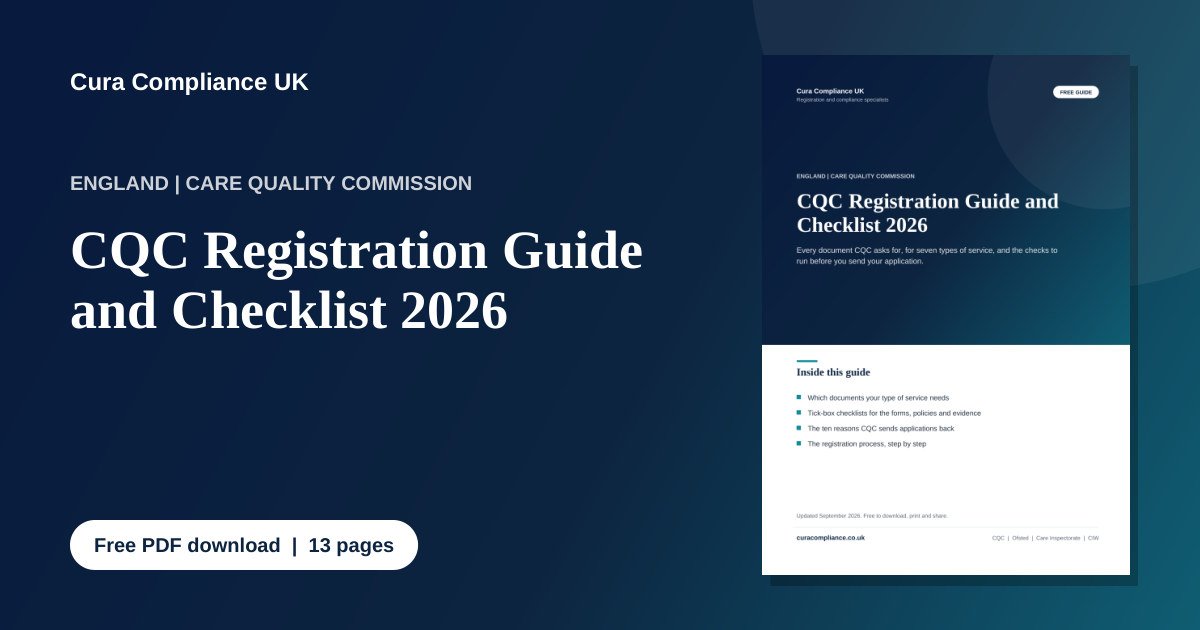
Free CQC registration guide and checklist
A 13-page PDF covering seven types of service, including dental practices. It lists the documents each one needs, such as the X-ray reports and HSE registration, and the checks to run before you apply.
Get the free guideThe words you will meet in your application
Ready to register your dental service?
No obligation. We confirm the regulated activities your dental service needs and what you still have to get, such as the CEAT report and HSE registration, as well as a realistic timeline for CQC registration.