Ofsted can refuse a registration, and a refusal has to be declared on every later application. Prepare before you apply.
Our free Ofsted registration guide for 2026 covers children’s homes, supported accommodation for 16 and 17 year olds, and nurseries. It shows the documents each service needs, with tick-box checklists for your people, policies and premises. It is a 10-page PDF with no sign-up. Work through it before you submit your SC1.
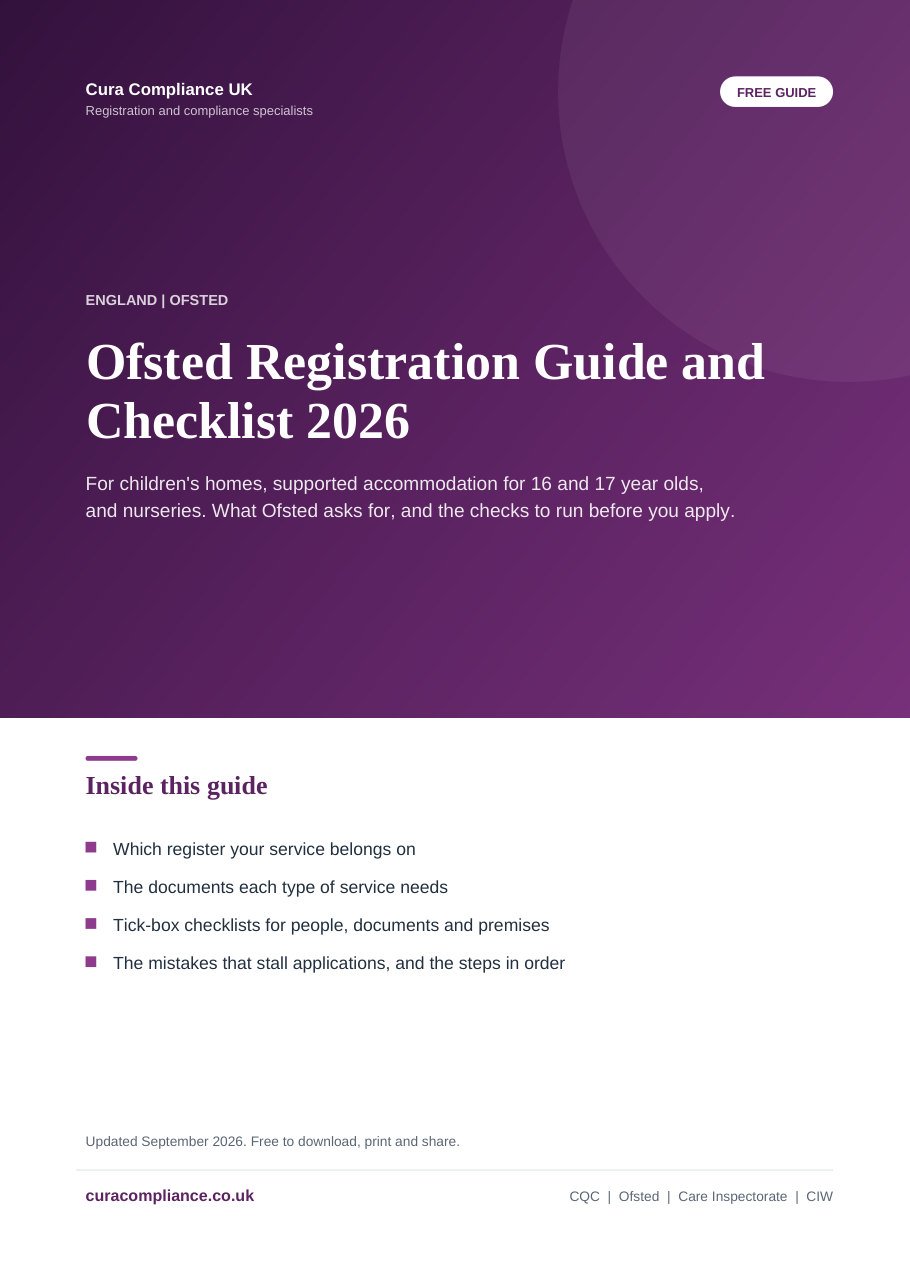
Download the free Ofsted registration guide (PDF, 10 pages)
Ofsted runs two separate routes. Children’s homes and supported accommodation register as children’s social care services, with an SC1 from the provider and an SC2 from each person linked to the application. Nurseries and pre-schools register on the Early Years Register through an online application. The guide covers both, and the first checklist helps you confirm which route you are on.
What is in the free Ofsted registration guide?
- A table showing which documents and checks each of the three service types needs.
- Seven tick-box checklists: the right registration, your people, the Statement of Purpose, the location assessment, policies and quality standards, premises and interviews, and nurseries.
- Eight mistakes that stall Ofsted applications.
- The registration process for children’s homes and supported accommodation, in eight steps.
Children’s home, supported accommodation or nursery?
| Service | Who it is for | Main law | How you apply |
|---|---|---|---|
| Children’s home | Children who need care and accommodation | Children’s Homes (England) Regulations 2015 | SC1, plus an SC2 for each linked person |
| Supported accommodation | Looked-after children and care leavers aged 16 and 17 who need support, not care | Supported Accommodation (England) Regulations 2023 | SC1, plus an SC2 for each linked person |
| Nursery or pre-school | Children under 5, on non-domestic premises | Childcare Act 2006 and the EYFS framework | Online application to the Early Years Register |
Supported accommodation can give support but not care. If a young person needs care, they need a children’s home, and a service that plans to give care under a supported accommodation registration is on the wrong route.
What Ofsted looks at most closely
For children’s homes and supported accommodation, five things decide most applications. The Statement of Purpose has to be written for this home, not copied from another. The location assessment has to analyse risks such as crime and exploitation and say what the home will do about them. A Registered Manager should be in post before you apply, because applications often stall at the interview stage without one. Policies have to be written for children, not adapted from adult care. And the Responsible Individual and the manager have to explain at interview, with real examples, how they will keep children safe.
For nurseries, the checks are more about people and premises: enhanced DBS checks for the childcare workforce, a health declaration, a manager with at least a level 3 qualification, paediatric first aid cover and premises ready for the registration visit. The revised EYFS framework in force from 1 September 2026 adds rules on safer sleep, safer eating and weaning, and screen use. Ofsted says early years applications take about 12 weeks on average.
How to use the guide
- Confirm your route with the first checklist before you spend money on a property.
- Appoint the Responsible Individual and the manager, and start their DBS checks early.
- Write the Statement of Purpose first, then the location assessment and policies to match it.
- Tick a box only when the item is final, and keep numbers, ages and needs the same in every document.
- Check the current guidance on GOV.UK on the day you apply.
How Cura Compliance can help
We write the Statement of Purpose and location assessment, complete the SC1 and SC2 forms, map policies to the quality standards and prepare the Responsible Individual and manager for interview. See our Ofsted registration support or the children’s home registration package, or book a free 30-minute consultation.
Also available free: the CQC registration checklist, the Care Inspectorate registration guide for Scotland and the CIW registration guide for Wales.
Frequently asked questions
Is the Ofsted registration guide free?
Yes. It is a free PDF download with no email sign-up. You can print it and share it, as long as you do not change it.
What is the difference between the SC1 and the SC2?
The SC1 is the provider’s application. It covers the organisation, the premises and the Statement of Purpose. The SC2 is completed by each person linked to the application, such as the Responsible Individual, the Registered Manager and directors, and covers their own details, suitability and checks.
Do I need a Registered Manager before I apply to Ofsted?
It is strongly advised. Ofsted interviews the manager before it decides, and applications without a manager often stall at that point while the property costs money every month.
How long does Ofsted registration take?
Since 18 September 2025 Ofsted fast-tracks only certain children’s homes, such as those with Department for Education capital funding or those needed in an emergency, and aims to decide them in 3 to 6 months. Ofsted says other applications are likely to take 6 to 18 months. Early years applications take about 12 weeks on average, and a new DBS check can add around 6 weeks.
Can supported accommodation provide care?
No. Supported accommodation provides accommodation and support for young people aged 16 and 17. A young person who needs care needs a children’s home.
Sources
- Ofsted: register a children’s home, guidance for applicants, checked September 2026
- Ofsted: register a supported accommodation service (SC1), checked September 2026
- Ofsted: childminders and childcare providers, register with Ofsted, checked September 2026
- The Children’s Homes (England) Regulations 2015
- The Supported Accommodation (England) Regulations 2023